
Identify every victim, even when there are many.
Disaster victim identification (DVI) assigns human remains to missing persons after a mass-casualty event. Identicore ADN solves the joint assignment of multiple missing persons and bodies with Likelihood Ratios, and VerumLims keeps custody of every sample.
The challenge
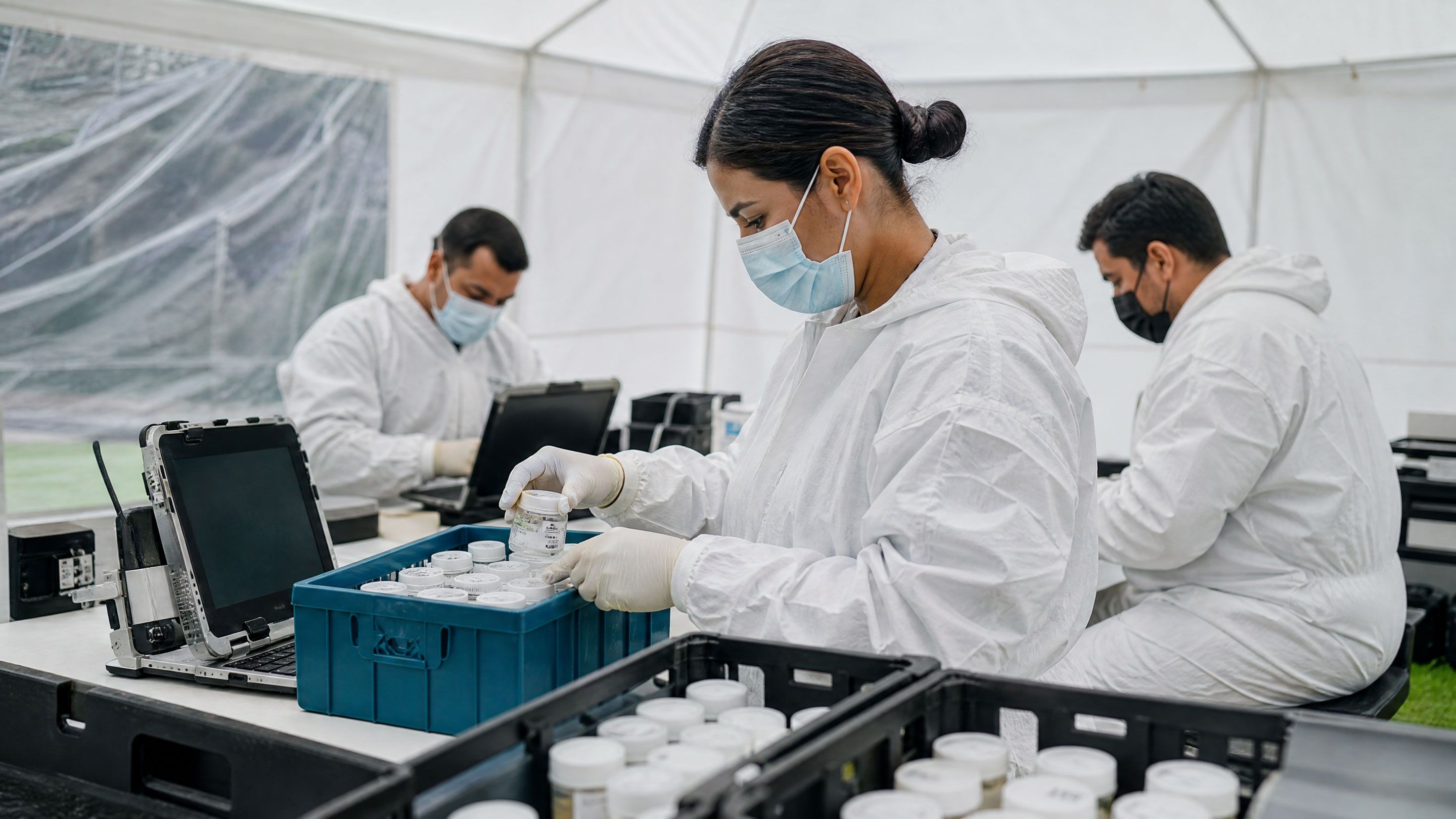
After a mass-casualty event there are many bodies or fragments, many families searching and enormous pressure for answers. Comparing case by case can assign two sets of remains to the same person, or miss that a profile fits another family better.
On top of that, every sample must keep its chain of custody from the scene to the expert report.
How we solve it
- 01
Intake and custody
Every sample enters VerumLims with a unique code, photo and digital chain of custody.
- 02
Reference families
Pedigrees of the relatives who provided samples are built, with any topology.
- 03
Joint assignment
Identicore ADN evaluates all missing persons against all bodies at once (GLR / joint-DVI), not one by one.
- 04
Degraded samples
Untyped loci are excluded from the calculation without penalizing or inflating the Likelihood Ratio.
- 05
Identification criterion
ICMP, ISFG, ENFSI or custom verbal scale; the ICMP preset applies log₁₀(LR) ≥ 6 for positive identification.
- 06
Review and report
The examiner reviews each assignment and issues the report with reproducible, audited results.


Frequently asked questions
What is disaster victim identification (DVI)?
It is the process of identifying the people who died in an event with many victims, by comparing the genetic profiles of the remains with those of their reference relatives.
Why use joint assignment instead of case by case?
Because evaluating all missing persons against all bodies at once avoids contradictory assignments, such as two sets of remains attributed to the same person, and reveals when a profile fits another family better.
What threshold is used for a positive identification?
The laboratory defines it with its verbal scale. The ICMP preset, recommended for humanitarian identification, considers a log₁₀(LR) of 6 or higher a positive identification.
Does it work with degraded remains?
Yes. Loci that could not be typed are excluded from the calculation without penalizing or inflating the result, and the coverage report shows which information was missing.
How is the chain of custody kept in a mass-casualty event?
VerumLims records every sample with a unique code and keeps an immutable record of every transfer and handling, from intake to archive.
Prepare for a mass-casualty event before it happens.
We'll walk you through a complete DVI scenario with test data.
Book a demo →